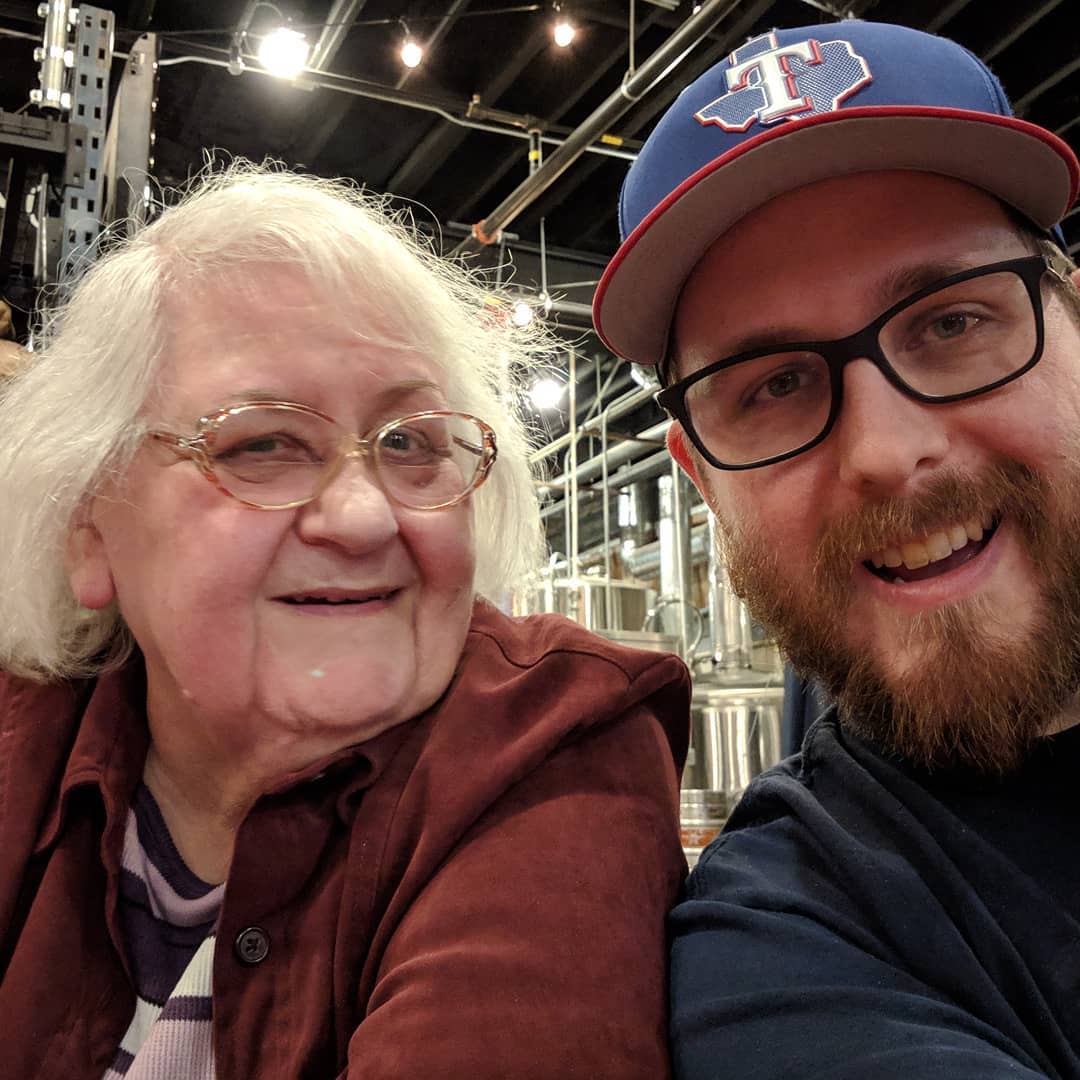
I’ve been writing this post in some form for nearly a year. While it is a post about liturgy and death intersecting, it is, for me, an exercise in working through grief.
My mom passed away a year ago today, so today is her “feast day,” so to speak. In the Catholic Church, the ideal date to celebrate a saint’s feast day is the anniversary of their death or their “heavenly birthday” (dies natalis).
I’ve experienced death before. My father died when I was 12. He died without family in the middle of the night in the hospital, without any of us realizing that he was on death’s door until 24 minutes before he died, when they called to tell us he had coded. His funeral was the first Mass that I could remember. I was baptized at 11 months old, and I don’t know if I ever went to Mass before or after until Dad’s funeral.
My grandparents have all died. My niece passed away. Uncles and friends. I’m not a stranger to death or to funerals. My mom’s death was the first one that I was present for.
Liturgy
Liturgy is the work of the People of God to worship and offer prayers to God in a formal way—as the Church being Church. Not just a group of individuals in community, but a group acting in the name of and with the authority of the whole Christian community.
It’s different than devotion. Praying a rosary is great! It is, though, fundamentally, a group of people praying on their own. Even if a million people are praying it together, it is, simply stated, a million people praying.
Every liturgy—every Mass, every Liturgy of the Hours, every sacrament—is the whole Church offering praise, petition, and adoration to the Father. This is one reason the Church does prescribe a ton on how to pray the Mass, but very little on how to pray the rosary.
That said, while liturgy is huge, it’s also meant to meet the moments of our lives. The sacrament of Confession is intimate. The Anointing of the Sick and the prayers around death find us at some of the most particularly personal parts of our lives. The whole Church prays for us in those moments, even if only a few are present.
My Mom’s Final Encounter with Liturgy
Or, better stated, her final encounter with liturgy on this side of eternal life.
I do not have the faith to believe it could have happened as it did.
It could only be in a corny Hallmark movie because it is too hokey to be real.
My mom’s final days and passing are something that will take a long time still to reflect on the many aspects of it. The actual moments of her passing were one of the most incredible moments of catechesis—religious teaching—I’ve ever been given.
The Stroke
Sometime before morning on August 24th, she suffered from a “massive stroke”. I was initially told she was unresponsive. A few hours later, she was awake and, once they took her off pressurized air, able to speak well enough to converse.
My siblings, who were closer and there, asked if they should call for a priest and how to do it. Simply let the nurses know—hospitals are good at this. They know how to make it happen. Different hospitals have different arrangements. Some have Catholic priests on staff; others have parishes or some kind of on-call system.
The priest heard she was “transitioning,” so he ran in trying to make it before her final moments. Somewhere in the communication process, the note that she was transitioning/transferring from the emergency department to ICU was lost—she wasn’t transitioning to the afterlife. Nevertheless, the priest offered her the various rites the Church provides when there is the danger of death.
My sister said “oh no, she just needs a blessing”. The priest, to his absolute credit, said it’s okay if we do this too early. It would be better to do it now than wait until it’s too late. She received the Anointing of the Sick and the Apostolic Pardon.
Mom understood what was happening and participated to the best of her ability.
(If you’re looking for a refresher on the “Last Rites”, check out the appendix below.)
The Commendation of the Dying
The Church has an extensive set of prayers and rites associated with sickness and death. Earlier this year, a new translation was published. I’m quoting from the older one below that was in effect when my mom passed away.
While the “Last Rites” prepare one for death, the Church has a liturgy available for the actual transition to the next life.
For my mom, she had the stroke on August 24th and she lost the ability to swallow. In the 10 days that followed, she spent time in hospice, surrounded by family and friends. She was slowly fading away, sleeping more and more each day. Mentally, she was still fairly sharp—definitely had a stroke and it definitely impacted her, but herself with more memories available and accurate than not.
By September 3rd, she had mostly slipped away, but she was still fighting. A day or two before, a priest came again to offer her the Anointing of the Sick, but she was more unconscious than not. My siblings and I wondered what she was waiting for. All the family who were able to visit did, and mostly while she was still awake enough to visit with them.
I was nervous. I’m the church-y one in the family. The Gospels note that often a “prophet is without honor in their native land”—it can be hard for those closest to you who know all of your flaws to accept you as a minister. My family has had a rough experience with the Church and I just didn’t know how it would land. But, I offered “The Church has some beautiful prayers to offer someone who is dying to God…do y’all think I could pray them?”
My sisters were willing.
The liturgy begins with short texts which can be used, any or all, once or repeated. Short scriptural verses like “Who can separate us from the love of Christ?” (Rom 8:35), “We have an everlasting home in heaven.” (2 Cor 5:1), “The Lord is my light and my salvation” (Ps 27:1).
Then, a longer reading is proclaimed. 13 options are given, but others can be used. I don’t recall which I read. Perhaps Psalm 25 (“To you I lift up my soul, O Lord my God…”) or Psalm 91 (“You who dwell in the shelter of the Most High…”).
Next in the liturgy, we prayed the Litany of Saints, invoking the saints to “pray for her”.
Prayer of Commendation
Next, the instructions say “When the moment of death seems near, some of the following prayers may be said” and I offered two of them at the moment.
Go forth, Christian soul, from this world
in the name of God the almighty Father,
who created you,
in the name of Jesus Christ, Son of the living God,
who suffered for you,
in the name of the Holy Spirit,
who was poured out upon you,
go forth, faithful Christian.May you live in peace this day,
may your home be with God in Zion,
with Mary, the virgin Mother of God,
with Joseph, and all the angels and saints.
I commend you, my dear sister, to almighty God,
and entrust you to your Creator.
May you return to him
who formed you from the dust of the earth.May holy Mary, the angels, and all the saints
come to meet you as you go forth from this life.May Christ who was crucified for you
bring you freedom and peace.
May Christ who died for you
admit you into his garden of paradise.
May Christ, the true Shepherd,
acknowledge you as one of his flock.May he forgive all your sins,
and set you among those he has chosen.May you see your Redeemer face to face,
and enjoy the vision of God for ever.℟. Amen.
Within seconds, she started the final stage of agonal breathing. Her body’s final moments as it shuts down. She had a shallow breath and…nothing for what felt like forever. Then, a gasp.
We said various things—she did good and she’s finished her job here. She can go back to Dad. She raised us well and we’re able to take it from here. Things like that.
Within 2 minutes, she was gone.
The hospice nurse verified and that was that.
I Still Struggle
Mom died exactly “on cue” when the liturgy called for it. The next thing in the liturgy literally says “When death has occurred, one or more of the following prayers may be said”.
I love the liturgy. It’s my prayer language without a doubt. I truly believe the liturgy is our way, as small and incapable as we are, of offering worship to the Father as a people—as a Church—and it is the most powerful way of interfacing with the divine…to become divine as we are Christ…the Body of Christ.
That said, I’ve never experienced the liturgy interfacing with earthly life like this. I’ve felt the imprint of the liturgy and the grace from it throughout my day plenty of times and often. But… this was different.
When reading the text before, I have to confess, I rolled my eyes a bit at this part. I thought to myself “what are the odds that people would be gathered and prepared to pray this at the moment of death”? I figured that someone would pray the commendation prayers right after they passed away perhaps. Or they would pray it, blessing the person, in advance of their death akin to the way my mom received the Anointing of the Sick in the day or two before her death.
But, in one voice with the whole Church, commending her to “go forth from this world” and… she does? Literally immediately after the prayers were offered.
I don’t have the faith
I pray that I’ll have the faith someday to believe it happened. Of course, I was there, I know it happened like that. But, a year later, I’m still in awe and don’t understand it.
The grief process is not linear. I do miss her at times I don’t expect or with an intensity I don’t expect. We didn’t talk relatively often or deeply later in her life and figuring out this grief is work.
But, when Dad died, none of us expected it. None of us were ready for it. None of us were able to say goodbye. None of us were spiritually prepared. He wasn’t spiritually prepared. He died alone.
A couple weeks shy of 28 years later, my mom had the opposite experience. We had the opposite experience. I am very grateful that we were able to walk with Mom in this way and we didn’t have to do it alone. I’m grateful the Church helped walk her to her final destination.
My thoughts are consumed by thinking of her today, on her feast day. I pray for her and ask that she pray for me.
Eternal rest grant unto them, O Lord, and let perpetual light shine upon them.
May their souls and all the souls of the faithful departed, through the mercy of God, rest in peace. Amen.
Appendix: Last Rites
This section is an explainer of the Church’s “Last Rites” for those who aren’t familiar or would like a refresher.
Often still referred to as the Last Rites, the Church has an extensive set of prayers and rites associated with sickness and death. Part of the Roman Ritual, it is the book Order of the Anointing of the Sick and of their Pastoral Care.
The text has several rites—everything from visiting a sick person at their home to an emergency rite for Christian initiation (deathbed conversion‽). For the sake of “Last Rites”, we’ll look at Penance, the Anointing of the Sick, and Viaticum.
Reconciliation / Penance
The same sacrament as when one goes to confession normally; when someone is in danger of death, the priest will offer to hear the person’s confession. For an ill person, the “confession may be generic”. Usually, confession should be specific—”I haven’t been a good husband” should have a follow-up of what you are accusing yourself of doing that made you a bad husband. When one is celebrating reconciliation as part of the last rites, the Church’s desire that the penitent deeply reflects on the specific actions so as to correct oneself moving forward is understandably a lower priority, and the Church understands the sick person may not be able to offer more than a generic confession.
If Reconciliation isn’t celebrated—for whatever reason—the priest leads those present with the penitential rite similar to what we use when starting the Mass.
In either case, at the conclusion, the priest can offer “the Apostolic Pardon”. The Church professes that while sin is forgiven, there are effects of that sin on the soul that require purification (e.g., purgatory). I make the analogy of a time when I was a kid: I had some trouble expressing my anger, and I once punched a hole in the wall in my room. I asked my mom for forgiveness—which she gave—but there was still a hole in the wall. I needed to heal the damage my anger caused, which I did by buying a patch kit and patching the drywall. I was forgiven as soon as I asked my mom and she gave it, but there was still a wound. Same basic idea here.
So, after the celebration of Reconciliation during the last rites, the Church offers a plenary indulgence (i.e., full pardon). Furthermore, if a priest isn’t available, the Church grants the same at the moment of death to any properly disposed Christian who “during life they have habitually recited some prayers”.
Anointing of the Sick
The Anointing of the Sick is one of the seven sacraments of the Catholic Church. Sacraments are visible, tangible signs instituted by Christ that confer interior grace on the recipient. In our theology, they convey grace by the very act. They are God’s gift to us to manifest his grace in the world.
In this sacrament, the priest anoints with oil the forehead and palms of the individual while praying. Typically, the oil will be olive oil that was blessed as the Oil of the Sick by the Bishop at the annual Chrism Mass, but if olive oil isn’t reasonably available, any natural vegetable oil can be used. If no blessed oil is available, the priest can bless the oil at the time of the sacrament.
This is done for any serious illness—physical or mental—or “old age”. It can be repeated if the person recovers and becomes ill again, or if the sickness worsens.
Viaticum
Viaticum is simply the Holy Eucharist, but administered when one is in danger of death as “food for the journey”. There’s little difference in how it is offered and received by the sick person, with the priest adding “May the Lord Jesus Christ protect you and lead you to eternal life” after reception.
This is different than simply receiving communion while in the hospital for any ole reason. This is specifically part of the last rites. Additionally, viaticum can virtually always be given. For example, on Holy Saturday, except for the Easter Vigil itself, communion can only be given as viaticum.
In summary, the so-called “last rites” are these three sacraments, celebrated in a specific way, to aid folks during one of the most sacred times as they prepare to return to the Creator. The Church’s rituals are very flexible to serve the particular situation—a lay person can give someone viaticum; if a priest doesn’t have the Eucharist on them, they can offer the other parts; a lot of the text can be skipped if time is critical; and so forth.
If you jumped down here to get the explainer after I mentioned the Anointing of the Sick and the Apostolic Pardon, you can jump back to the next part of the piece on the Commendation of the Dying.




Leave a Reply